
BECA 506

Description
The BECA 506 profile is a D-Ring seal designed for piston sealing in industrial applications. Its specific "D" shape improves stress distribution and offers greater stability compared to traditional O-rings.It is suitable for both static and dynamic environments, providing a reliable, durable solution for systems subject to mechanical and thermal stress.
Advantages
Reduced risk of extrusion and leakage due to its unique geometry
Improved stress distribution and reduced wear
Compatible with a wide range of materials and fluids
Easy installation and excellent resistance to seizure
Good performance under pressure, temperature fluctuations and dynamic movement
Technical data
| Temperature | -40°C / +200°C |
|---|---|
| Pressure | Elastomers |
| Speed | 0.5 m/s max |
| Medias | Mineral and synthetic oils, HFA, HFB, HFC and HFD hydraulic fluids, fluides hydrauliques HFA, HFB, HFC et HFD |
Applications
Automotive (freinage, suspension, direction assistée)
Machine tools
Hydraulic presses
Agriculture
Construction
Hydraulic pumps and motors
Materials
Elastomer
AEM 60-70-80-90 Shore A
FKM 60-70-80-90 Shore A
HNBR 60-70-80-90 Shore A
NBR 60-70-80-90 Shore A
Polyurethane
PU 93 Shore A - Blue
PU 96 Shore A - Blue
PU 98 Shore A - Blue
PU High Temp. 96 Shore A - Beige
Download
Dimensions
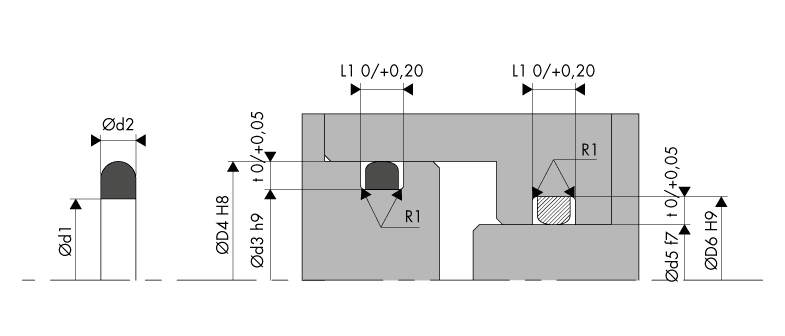
Materials
Elastomers
ACM (Polyacrylate)
ACM is an ethyl acrylate (of butyl acrylate) polymer containing a small amount of cross-linking monomer; it is more hea-resistant than NBR. It is frequently used in automatic transmissions.
| Chimical resistance | Mineral oils (engine oils, gear oils, ATF) Atmospheric agents and ozone |
|---|---|
| Compatibility issue | Glycol-based brake fluids (Dots 3&4) Aromatic and chlorinated hydrocarbons Water and steam Acids, alkalis, amines |
| Temperature range | -25°C up + 150°C (peak at +160°C) -35°C / +150°C up to special ACM |
FKM (Fluoro rubbers)
Depending on their structure and fluorine content, fluoroelastomers can vary in terms of chemical and low-temperature resistance. This FKM-based elastomer is widely used in high-temperature hydraulic and pneumatic applications, industrial valves, fuel injection and carburation systems, engine gaskets and high-vacuum applications.
| Chemical resistance | Mineral oils and greases, ASTM No. 1, IRM 902 and IRM 903 oils Fire-resistant fluids (HFD) Silicone oils and greases Mineral and vegetable oils and fats Aliphatic hydrocarbons (propane, butane, petroleum) Aromatic hydrocarbons (benzene, toluene) Chlorinated hydrocarbons (trichlorethylene) Petrol (including high-alcohol content) Atmospheric agents and ozone |
|---|---|
| Compatibility problems | Glycol-based brake fluids Ammonia gas Low-molecular-weight organic acids (formic and acetic acids) |
| Temperature range | -20°C / +200°C (peak at +230°C) -40°C / +200°C with special FKM |
HNBR (Hydrogenated Nitrile Butadiene Rubber)
This HNBR-based elastomer is obtained through the selective hydrogenation of the butadiene groups in NBR. It is commonly used in power steering and air conditioning systems.
| Chemical resistance | Aliphatic hydrocarbons Mineral and vegetable oils and fats Hard-to-ignite fluids (HFA, HFB and HFC) Dilute acids, bases and saline solutions at moderate temperature Water and steam up to +150°C Atmospheric agents and ozone |
|---|---|
| Compatibility problems | Chlorinated hydrocarbons Polar solvents (ketones, esters and ethers) Strong acids |
| Temperature range | -30°C / +150°C (peak at +160°C) -40°C / +150°C with specials HNBR |
NBR (Nitrile Butadiene Rubber)
Nitrile rubber (NBR) is the general term for acrylonitrile-butadiene copolymer. The ACN content can range from 18% to 50%. The higher the acrylonitrile content, the better the resistance to oil and fuel; conversely, elasticity and compression set are inferior. NBR exhibits good mechanical properties and wear resistance, but its resistance to atmospheric agents and ozone is relatively poor.
| Chimical resistance | Aliphatic hydrocarbons (propane, butane, petroleum, diesel fuel) Mineral oils and grease Hard-to-ignite fluids (HFA, HFB and HFC) Dilute acids, alkaline and saline solutions at low temperatures Water (up to +100°C max) |
|---|---|
| Compatibility problems | High-aromatic fuels Aromatic hydrocarbons (benzene) Chlorinated hydrocarbons (trichloroethylene) Polar solvents (ketone, acetone, acetic acid, ethylene ester) Strong acids Glycol-based brake fluids Atmospheric agents and ozone |
| Temperature range | -30°C / +100°C (peak at +120°C) -40°C / +100°C with specials HNBR |
PU (Polyurethane)
Polyurethane is a material that got the elastic properties of rubber. The proportions of the components in its formulation (diiscocyanate, polyol, chain extender) determine its properties. This material is characterized by high mechanical strength, good wear resistance, a high modulus of elasticity, good flexibility and excellent resistance to ozone and oxidation.
| Chemical resistance | Pure aliphatic hydrocarbons (propane, butane) Mineral oils and fats Silicone oils and greases Water up to +50°C |
|---|---|
| Compatibiliy problems | Ketones, esters, ethers, alcohols, glycols Hot water, water vapor, alkalis, amines, acids |
| Temperature range | -30°C / +90°C -30°C / +110°C with our special PU (+150°C on peak) |
The table below provides an overview of the physical, chemical and mechanical properties of each material.
| Caracteristics / Materials | ACM | FKM | HNBR | NBR |
|---|---|---|---|---|
| Abrasion resistance | 2 | 2 | 2 | 2 |
| Acid resistance | 4 | 1 | 1 | 3 |
| Chemical resistance | 4 | 1 | 2 | 2 |
| Cold resistance | 4 | 4 | 2 | 2 |
| Dynamic properties | 3 | 2 | 1 | 2 |
| Eletrical properties | 3 | 4 | 3 | 3 |
| Flame resistance | 4 | 1 | 4 | 4 |
| Heat resistance | 1 | 1 | 1 | 2 |
| Impermeability | 1 | 2 | 2 | 2 |
| Oil resistance | 1 | 1 | 1 | 1 |
| Ozone resistance | 1 | 1 | 2 | 4 |
| Tear resistance | 2 | 3 | 2 | 2 |
| Résistance à la traction | 3 | 1 | 1 | 2 |
| Résistance à l'eau / vapeur | 4 | 3 | 1 | 2 |
| Résistance aux agents atmosphériques | 1 | 1 | 2 | 3 |
1. Excellent properties 2. Good properties 3. Average properties 4. Poor properties
Chemical compatibility
A "chemical compatibility guide" catalog is available for download in the literature section. You can also use our free online chemical compatibility tool.
These two resources allow you to assess how our materials behave in contact with most common fluids. The data presented are the result of rigorous testing at room temperature and reflect the latest published information. Please note that these test results may not be fully representative of real-world performance due to the specific nature of your application; the tests do not account for additives or impurities present in actual operating conditions, nor do they cover potential high-temperature extremes. Other factors—such as hardness, compression set, and abrasion resistance—can also affect material performance. We therefore recommend conducting your own tests to verify the compatibility of our materials with your specific application. Our technical team is available to provide further information.
Only on request