
BECA 143



Description
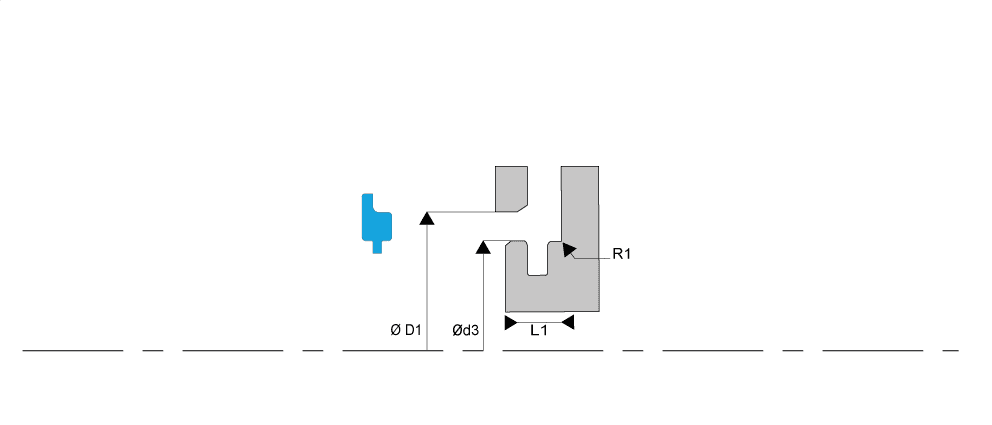
The BECA 143 profile is a seal with a vertical sealing lip, an elastomer body, and a retaining tab. This seal is designed for static applications. It is installed by stretching into an open groove. It ensures static sealing at the level of the counter-face chamfer. An integrated tab on the inner diameter keeps the seal in place during transport or handling stages prior to final assembly.
Advantages
Leakage risk reduction
Easy assembly
Functional in open grooves
Technical data
| Temperature | -60°C / +200°C |
|---|---|
| Pressure | * |
| Speed | * |
| Medias | Mineral hydraulic oils |
Applications
Automotive
Industrial equipment
Aerospace
Materials
Elastomer
EPDM 70 - 80 - 90 Shore A
FKM 70 - 80 - 90 Shore A
HNBR 70 - 80 - 90 Shore A
NBR 70 - 80 - 90 Shore A
VMQ 70 - 80 - 90 Shore A
Download
Dimensions
Materials
Elastomers
ACM (Polyacrylate)
A polymer of ethyl acrylate (or butyl acrylate) containing a small amount of monomer required for cross-linking. ACM is more heat-resistant than NBR and is frequently used for automatic gearboxes.
| Chemical resistance | Mineral oils (engine, gearbox, ATF oils). Atmospheric agents and ozone |
|---|---|
| Compatibility issues | Glycol-based breake fluids (Dot 3&4) Aromatic and chlorinated hydrocabons Water and steam Acids, alkalis, amines |
| Temperature range | -25°C to + 150°C (short-term peaks at +160°C) +150°C with special ACM grades |
AEM (Ethylène - Acrylate rubber)
A copolymer of ethylene and methyl acrylate, AEM is considered more heat-resistant than ACM. Its characteristics position it as an intermediate between ACM and FKM.
| Chemical resistance | Coolants Aggresive mineral oils Weathering agents Water |
|---|---|
| Compatibility issues | Aromatic solvants Strong acids Brake fluids Gearbox oils ATF oils |
| Temperature range | - 40°C to + 150°C |
CR (Polychloroprene)
This CR-based elastomer is used in the refrigeration industry and for ventilation systems. Chloroprene was the first synthetic rubber developed and commercialized.
| Chemical resistance | Paraffinic mineral oils Silicone oils and greases Water and water solvents at low temperature Refrigerants Ammonia Carbon dioxide Weathering agents and ozone |
|---|---|
| Limited chemical resistance | Naphtenic mineral oils Aliphatic hydrocarbons (propane, butane, petroleum) Glycol-based brake fluids |
| Compatibility issues | Aromatic hydrocarbons (benzene) Chrlotinated hydrocarbons (trichloroethylene) Polar solvents (ketones, acetone, acetic acid, ethylene-ester) |
| Temperature range | -40°C / +100°C (short-term peaks at +120°C) |
EPDM (Ethylene - Propylene - Diene - Rubber)
Commonly used for hot water valves, cooling systems, braking circuits, dishwashers, and washing machines.
| Chemical resistance | Hot water and steam up to +150°C Glycol-based (Dot 3 & 4) and silicone-based (Dot 5) brake fluids Organic and inorganic acids Cleaning agents, sodium and potassium alkalis Hydraulic fluids (HFD-R) Silicone oils and greases Polar solvents (alcohols, ketones, esters) Weathering agents and ozone |
|---|---|
| Compatibility issues | Mineral oils and greases Hydrocarbons Low gas impermeability |
| Temperature range | -45°C / +150°C (short-term peaks at +175°C) |
FFKM (Perfluorinated Rubber)
Offers the best characteristics in terms of high-temperature resistance and excellent chemical inertness. Often used for high-temperature hydraulics and pneumatics, industrial valves, injection/carburetion, engine seals, and high vacuum.
| Chemical resistance | Aliphatic and aromatic hydrocarbons Polar solvents (ketones, esters, ethers) Organic and inorganic acids Water and steam High vacuum |
|---|---|
| Compatibility issues | Refrigerants (R11, R12, R13, R113, R114, etc.), PFPE. |
| Temperature range | -15°C / +320°C |
FKM (Fluorinated Rubber)
Chemical and cold resistance vary depending on the structure and fluorine content. Widely used for high-temperature hydraulics and pneumatics, industrial valves, injection/carburetion, engine seals, and high vacuum.
| Chemical resistance | Mineral oils and greases (ASTM n°1, IRM 902, IRM 903) Flame-retardant fluids (HFD) Silicone oils and greases Vegetable oils Aliphatic and aromatic hydrocarbons Chlorinated hydrocarbons Gasoline (including high alcohol content) Weathering and ozone |
|---|---|
| Compatibility issues | Glycol-based brake fluids Ammonia gas Low molecular weight organic acids (formic and acetic acids |
| Temperatuer range | -20°C / +200°C (short-term peaks at +230°C) -40°C / +200°C with special FKM grades |
FVMQ (Fluorosilicone Rubber)
Physical and mechanical properties are very similar to VMQ, but FVMQ offers better resistance to fuel and mineral oils. However, hot air resistance is lower than VMQ.
| Chemical resistance | Aromatic mineral oils (IRM 903 oil) Fuels Low molecular weight aromatic hydrocarbons (benzene, toluene) |
|---|---|
| Temperature range | -70°C / +175°C |
HNBR (Hydrogenated Nitrile Butadiene Rubber)
Obtained by selective hydrogenation of NBR butadiene groups. Commonly used for power steering and air conditioning.
| Chemical resistance | Aliphatic hydrocarbons Mineral/vegetable oils and greases Flame-retardant fluids (HFA, HFB, HFC) Diluted acids/bases and salt solutions at moderate temperatures Water and steam up to +150°C Weathering and ozone |
|---|---|
| Compatibility issues | Chlorinated hydrocarbons Polar solvents (ketones, esters, ethers) Strong acids |
| Temperature range | -30°C / +150°C (short-term peaks at +160°C) -40°C / +150°C with special HNBR grades |
NBR (Nitrile Butadiene Rubber)
The ACN content can vary from 18% to 50%. Higher ACN content improves oil and fuel resistance but reduces elasticity and compression set. NBR has good mechanical properties but low resistance to weathering and ozone.
| Chemical resistance | Aliphatic hydrocarbons (propane, butane, petroleum, diesel) Mineral oils and greases Flame-retardant fluids (HFA, HFB, HFC) Diluted acids, alkaline and salt solutions at low temperatures Water (up to +100°C max) |
|---|---|
| Compatibility issues | High aromatic fuels Aromatic/chlorinated hydrocarbons Polar solvents Strong acids Glycol-based brake fluids Weathering and ozone |
| Temperature range | -30°C / +100°C (short-term peaks at +120°C) -40°C / +100°C with special NBR grades |
VMQ (Silicone Rubber)
Often used for carburetion applications.
| Chemical resistance | Animal and vegetable oils and greases Water at moderate temperature Diluted salt solutions Weathering agents and ozone |
|---|---|
| Compatibiliy issues | Superheated steam up to +120°C Low molecular weight chlorinated hydrocarbons Aromatic hydrocarbons |
| Temperature range | -60°C / +200°C (short-term peaks at +230°C) |
The table below provides an overview of the physical, chemical, and mechanical characteristics for each of the materials.
| Characteristics | ACM | AEM | CR | EPDM | FFKM | FKM | FVMQ | HNBR | NBR | VMQ |
|---|---|---|---|---|---|---|---|---|---|---|
| Abrasion resistance | 2 | 3 | 2 | 2 | 4 | 2 | 4 | 2 | 2 | 4 |
| Acid resistance | 4 | 3 | 2 | 2 | 1 | 1 | 3 | 1 | 3 | 3 |
| Chemical resistance | 4 | 2 | 2 | 1 | 1 | 1 | 1 | 2 | 2 | 2 |
| Cold resistance | 4 | 2 | 2 | 2 | 3 | 4 | 2 | 2 | 2 | 2 |
| Dynamic properties | 3 | 3 | 3 | 2 | 3 | 2 | 4 | 1 | 2 | 4 |
| Electrical properties | 3 | 3 | 3 | 2 | 1 | 4 | 1 | 3 | 3 | 1 |
| Flame resistance | 4 | 4 | 2 | 4 | 1 | 1 | 2 | 4 | 4 | 3 |
| Heat resistance | 1 | 1 | 2 | 2 | 1 | 1 | 1 | 1 | 2 | 1 |
| Impermeability | 1 | 1 | 2 | 2 | 2 | 2 | 4 | 2 | 2 | 4 |
| Oil resistance | 1 | 3 | 2 | 4 | 1 | 1 | 2 | 1 | 1 | 2 |
| Ozone resistance | 1 | 1 | 2 | 1 | 1 | 1 | 1 | 2 | 4 | 1 |
| Tear resistance | 2 | 3 | 3 | 1 | 4 | 3 | 4 | 2 | 2 | 4 |
| Tensile strength | 3 | 2 | 2 | 1 | 2 | 1 | 3 | 1 | 2 | 4 |
| Water / Steam resistance | 4 | 4 | 3 | 1 | 2 | 3 | 3 | 1 | 2 | 3 |
| Weathering resistance | 1 | 1 | 1 | 1 | 1 | 1 | 1 | 2 | 3 | 1 |
1. Excellent properties 2. Good properties 3. Average properties 4. Poor properties
Chemical compatibility
A "Chemical Compatibility Guide" catalog is available for download in the Documentation section. You can also use our free online "Chemical Compatibility" tool.
Both resources allow you to evaluate material behavior in contact with most existing fluids. The data displayed results from meticulous testing at room temperature and reflects the latest publications. Test results should not be considered 100% representative of reality due to the specificities of your application (additives, impurities, or high temperatures). We recommend performing your own tests to confirm compatibility for your specific application. Our technical team is at your disposal for any further information.
Technical data
Housing/shaft tolerance
The following mechanical tolerances are recommended for optimized performance:
- Housing/shaft diameter: h11
Due to the seal’s design and the nature of the sealing material, axial play is acceptable (please consult our experts).
Surface finish
| Roughness | Ra µm | Rz µm | Rmax µm |
|---|---|---|---|
| Static radial | ≤1.6 µm | ≤ 6,3 µm | ≤ 10.0 µm |
| Static axial | ≤ 1.6 µm | ≤ 6.3 µm | ≤ 10.0 µm |
The surface finish must not have a Ra < 0.05 µm.
Only on request